
Your cat has a tattoo but what does it mean?
Did you know most spayed/neutered cats have ear tattoos in Manitoba? Today, we’re going to help you read cat tattoos and explore the different kinds you might find in their ears. Did you know that you can help get a lost cat home just by reading their tattoo? Does your cat have a tattoo? ID tattoos are linked to you via records at the clinic, or rescue/shelter, that have placed them in a cat’s ear. They are only as good as the information attached, so make sure you update the clinic that did your cat’s tattoo. Not sure which clinic spayed/neutered your cat, or a cat you found? Read on!
Have you ever looked in your cat’s right ear? If there’s nothing obvious there, look a little deeper in the ear – sometimes tattoos are further down. If you didn’t find one at all, you either haven’t had your cat spayed/neutered or your cat had surgery at a clinic that doesn’t do them automatically. Some clinics don’t have the equipment, some charge for a tattoo and you need to authorize it, and some only offer microchips (inserted under the skin between the shoulder blades with no anesthesia needed). If you looked and found a tattoo in your cat’s right ear, congratulations! Someone will be able to get them home just by reading their tattoo. While microchips have become more popular in recent years, the majority of cats in Manitoba still get tattoos. Why? Because it is a visual form of ID that people can often read. Microchips require scanners and a trip to the vet.
In this article, we’re going to focus on Manitoba tattoos. Other provinces west of Manitoba also do animal ID tattoos. We’ll explore that at the end of this article.
Kinds of Tattoos
Right Ear tattoos
Did you know RIGHT ear tattoos mean you cat has been spayed or neutered? That’s right. Not only does the code mean something, the fact that it’s in the right ear also has meaning. We’ll talk about left ear tattoos later on.
tattoo Code
Manitoba uses a standard method for cat tattoos. Actually, they use this method for ANY pet tattoos, but we’re concentrating on cats here. All tattoos come with letters and numbers. Most tattoos will have letters first, followed by a series of numbers. There are some exceptions for rescues who have chosen a different order for the characters, but that is rare. You’ll find, for the most part, cat tattoos are done in black, or dark blue, ink. However, we’ve also seen some from rural areas done in a light blue-green ink.
tHE FIRST LETTER
The FIRST letter in a cat’s tattoo is the YEAR the tattoo was placed. Manitoba uses the entire alphabet, minus the letters I, O, Q, V because they look too similar to other letters. Each letter corresponds to a year, which starts again once the tattoos reach the letter “Z.” This works because most pets don’t live longer than the number of letters in the alphabet.
So, what letter is 2025? 2013 was “A” year and the start of the alphabet again, so 2025 is “N” year. All cats done in 2025 will start with the letter “N” no matter which clinic does the tattoo.
tHE REMAINING LETTERS
After the first letter, you might find one, two, or even three more letters. Those letters correspond to the clinic (or organization) that did your cat’s tattoo – the clinic code. You can tell which clinics have been around a long time because they have a single letter for their clinic code. The Winnipeg Humane Society (WHS) is the letter “A” and you’ll find a lot of tattoos with that clinic code because they do the majority of spays and neuters in Manitoba. Did you know WHS does more than 6,000 spays and neuters a year? They have had years where they’ve even reached just over 7,000! Alpine Animal Hospital (formerly known as the Winnipeg Spay and Neuter Clinic) is the letter “B.” The Manitoba Veterinary Medical Association maintains a tattoo list of all the clinics, their tattoo codes and tattoo years, which they update regularly.
So now that you know what the letters mean, how would you read a tattoo whose letters are UCSC?
“U” year was 2008 and CSC is the clinic code for Craig Street Cats. From this information, you can even estimate how old a cat might be. A “U” cat would be, at least, 17 years old. If you picked up a cat and their tattoo started with what looked to be a “U,” you could even determine if you read the tattoo correctly. Does the cat look old or young? If they look young, you may have read the year code incorrectly.
tHE NUMBERS
Lastly, we have numbers in the tattoo. There is no cryptic meaning here. Simply, this part of the tattoo code just refers to the number of animals that clinic has tattooed to-date. If your cat’s tattoo numbers are 345, they are the 345th tattoo done in that year, at that clinic. Numbers can also help you determine if you’ve read a tattoo correctly.
There is NO OTHER CLINIC that does more than a couple of thousand tattoos a year than the Winnipeg Humane Society. So, if the cat you’ve picked up has a tattoo that you think reads GH5487, you’ll want to have a second look. When you see the clinic code corresponds to Corydon Animal Hospital and realize the cat has four numbers in the tattoo, you’ve made a mistake reading the “H.” Remember, WHS is the ONLY clinic that would have four numbers that reach the 5,000 mark. An H can easily look like an “A” if it’s faded or not clear enough.
Not sure if the tattoo has been read correctly? You can call the clinic and ask if their tattoo numbers go as high as the one in the cat’s ear. If they do, you can read them the tattoo and see if the code corresponds with the description of the cat. They can, then, contact the family to see if the cat is missing or what the situation might be.
POSITION OF TATTOO IN THE EAR
Tattoos are usually done on two lines, with letters over numbers. Most clinics try to get the tattoo done at the head level so you can still read it, but to also protect it from frostbite. Cats often lose their ear flaps if they’re outside in the winter. Knowing that the top row is all letters and the bottom row is all numbers is helpful in cases where you need to know if you have to guess at faded characters. There will never be a letter mixed in with the numbers and vice-versa.
Sometimes, though, if a cat has a low number, and the clinic code doesn’t have a lot of letters, they can appear all on one line. This makes it more confusing to decipher if it is faded as you might be misreading a letter or a number. I’ve advocated for a universal method in the past because of this difficulty. For instance, if a cat is the clinic’s 6th client and they’re clinic code is “AR,” they could fit NAR6 on one line. I’ve also seen one line tattoos done verically in the ear, which makes it even more difficult to the untrained eye. People read horizontally. Most tattoos are done this way, so vertically is unexpected, but consider it exists – rarely.
Left Ear tattoos
If the RIGHT ear tattoo information seems a little daunting, know that LEFT ear tattoos aren’t usually done for ID purposes. While there are some independent breeders who do their own tattoos in left ears, we have found these to be very few and far between. Those we’ve seen in past years have come from Saskatchewan, and are done in a light, blue-green ink. We were surprised to find ONE cat from rural Manitoba with one of these from a clinic, but that was literally one in the last 12 years.
Most left ear tattoos are vanity tattoos. One Valentine day, in the past, the Winnipeg Humane Society clinic was offering left ear heart tattoos to raise money for the organization. Some of my own cats have vanity tattoos because I knew an animal health technologist who loved doing them. You’ll sometimes find the cat’s name in the left ear, or a symbol like a heart. I have also used a single, large “T” in the left ear to indicate the cat was part of my TNR program. I wanted it easy to see in case the cat was retrapped during TNR season. Most rescues don’t use this method. Suffice it to say left ear tattoos can help get a cat home because they are uncommon, and often very unique.
Abdominal tattoos
These types of tattoos are extremely rare in Manitoba. They are usually limited to breeders who have them done instead of an ear tattoo to let people know an animal has been spayed. You wouldn’t know they existed until the animal was shaved for a spay and then you’d see blue-green lines or dots on the abdomen. They don’t provide any information beyond that, unfortunately.
Manitoba tattoo anomalies
Many rescues and shelters have their own tattoo codes. They don’t use their vet clinic’s code. For instance, Rescue Siamese uses “RS” as their clinic code even though RS isn’t a clinic. We can call this a rescue code. They serve the same purpose as a clinic code. It’s a nice option so they instantly know which cats are theirs if they wind up at a shelter or someone’s home.
All rescues, except D’Arcy’s ARC has historically used the same order of letters and numbers as clinics. D’Arcy’s ARC has changed their code sequence at least twice over the decades, having started out with a numbering system and moving to one that’s more like what we see with clinic codes, but in a different order. Their rescue code is “ARC.” It seems obvious and simple enough but can get confusing because we also have Red River College doing animal tattoos through their Animal Health Technology course. Their clinic code is “RC.”
Theoretically, if a cat is done through RRC in “A” year, the cat’s tattoo would read “ARC” as well, and have low numbers underneath. In any year other than an “A” year, this wouldn’t be a problem. Our last “A” year was 2013 and those cats are still alive, so if you find an “ARC” cat, you have to do a little more homework to get the cat home.
out of province tattoos
It is rare to find cats roaming Manitoba that are from other provinces, but it does happen. Areas east of Manitoba, in Canada, do not tattoo. Ontario to Newfoundland, they use microchips. West of Manitoba, Alberta and BC tattoo and Saskatchewan is a mixed bag of chips and tattoos (they mostly use microchips). Alberta does their tattoos exactly like Manitoba, so if you find a cat whose tattoo is very clear and it doesn’t match up with a clinic’s description of the cat, they might be from Alberta. You can check out the ABVMA’s master tattoo list. BC’s tattoo lettering is in a different order. They do the mirror of what Manitoba does. Their numbers are first, then their clinic code and lastly, the year code. It’s easy to tell cats from BC and you can check out their tattoo list from the BC Pet Registry.
tattoo reading is an art and science
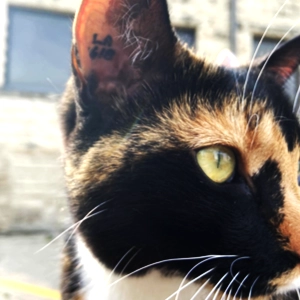
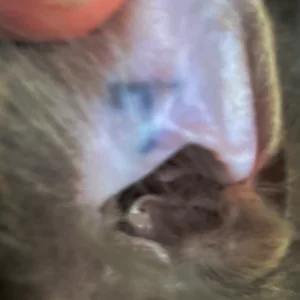
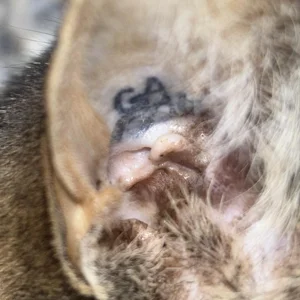
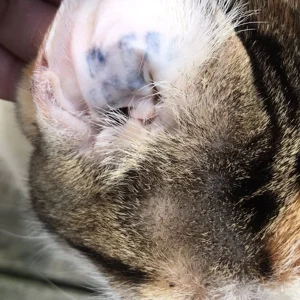
Over the past 25 years, I’ve done a lot of tattoo reading. You get good at being a detective when the tattoos aren’t bright and easy to read. When you’re dealing with faded ink, you have to know what you’re doing in order to get the code correct. Check out the photos. Mouse over or click on each photo to see what the tattoo reads. Were you able to see the same letters and numbers? What was your guess? What can you do to get a tattoo right?
Tattoo reading checklist
Seeing the tattoo clearly
- Make sure you look deeper in the ear if you don’t see an obvious tattoo.
- Look in the left ear for a vanity tattoo.
- Clean the ear flap. Oftentimes lost cats have ear mites and debris builds up and obscures the tattoo. Use some olive oil on a Q-tip and just rub the ear mite dirt away until the flap is clean. Don’t go down into the canal because a tattoo won’t be that deep.
- If the tattoo is there, no ear mites, but is a little dirty, just use some rubbing alcohol on a swab to clean the skin where the tattoo is.
reading the tattoo
- Flip the ear flap over your finger to read the tattoo, if you can’t read it as is, or take a photo of it. Sometimes its easier to read enlarged or edited (change the contrast, brightness, and other settings in a photo editing app).
- If the tattoo is faded and your can’t read it using daylight or via a photo, use a concentrated light (flashlight or phone light). Press the light right up against the back of the ear, so the light shines through, while reading from the front. You’ll need a helper for this. Being in a totally dark room also helps with this method. You’d be surprised to see letters you can’t see at all come through with this method.
- Write down what you think the tattoo reads. Look at the letters and numbers. Do they make sense? Do the letters correspond to an existing Manitoba code? Do the numbers make sense for that clinic? Does the year code match how the cat looks (young or old)?
troubleshooting
- If there are letters that don’t match a year code or clinic code, look at the letter shapes. Are they round or angular? Which other letters could look like what you’re seeing? Which numbers look similar to what you’re seeing? Write down possible combinations.
- Get a second opinion. Send the photo to someone who has a lot of experience reading tattoos (WHS, other rescues, shelters and clinics).
- If you’ve tried all these methods and still haven’t gotten a match, take the cat to WHS or a clinic, to have the tattoo read. They can also scan the cat for a microchip while they’re at it.
wLCA can provide a second opinion
If you’re having trouble reading a tattoo, take several photos of it at different angles as well as photos of the cat. Fill out the WLCA contact form and describe the situation. Once we receive your info, you’ll get a request for the photos via email. We’re always happy to help get a cat home!